Showing posts with label snow plein air. Show all posts

Tuesday, June 13, 2017

Hoosier Women Artists Statehouse Reception 051917

"Ice Cold Reflections, January 21, 2017", plein air oil, 12" x 12", c. 2016, by Charlene Marsh.
I recently entered a plein air snow scene, painted deep in the forest, into a competition sponsored by the Indiana Arts Commission to select work to hang in the Statehouse in the Lieutenant Governor's Office, Auditor's Office and Treasurer's Office. 

Entrants were only allowed to enter one piece so I entered a favorite snow scene that I am not ready to sell and was notified that my painting was selected to hang in the Statehouse in the Lt. Governor's Office!  The painting will be in the Statehouse for a year and then, afterwards, travel to the Haan Mansion Museum of Indiana Art, in Lafayette, Indiana for three months.  I won't get it back until November, 2018. 


Charlene Marsh with her winning entry.

This year, they staged a lovely reception and ceremony giving all accepted artists a frame-able certificate.  Lieutenant Governor Suzanne Crouch and other dignitaries spoke during the presentation. 

Here is the beautiful reception hall in the Statehouse as people are arriving.  Our paintings were arranged on easels around the perimeter.


This competition was first held in 2009 and there were over 100 entries and only seven were accepted.  This year there were 208 entries and 34 accepted.  The first year, I dropped off my painting at the Lt. Governor's Office and that was it.   

Lieutenant Governor Suzanne Crouch speaking during the ceremony.

So this year was quite a pleasant contrast to my experience in 2009.


Lieutenant Governor Suzanne Crouch and Charlene Marsh with her plein air oil painting, "Ice Cold Reflections, January 21, 2016", Code #012116 12x12, c. 2017.
Indiana's First Lady, Janet Holcomb, also attended the reception with First Dog, Henry.  Henry, a Schnauzer, has his own Twitter account, @FirstDogHenry.  
Charlene Marsh and First Lady, Janet Holcomb, with First Dog, Henry.

As it turns out, Mrs, Holcomb grew up in Muncie, Indiana, my hometown, and majored in Fine Art at Ball State University.  Not only that, we both graduated from the same high school, Muncie Burris Laboratory School which is a really small school.  Only fifty kids in my graduating class.  Rare to meet a fellow graduate from my alma mater!  So we really hit it off.  And, of course, anyone who loves their dog enough to bring him to the Statehouse is my kind of First Lady!
First Lady, Janet Holcomb, and Charlene Marsh with her oil painting at the Statehouse.

I wore a vintage dress that had been my grandmother's, circa 1947, that the Lt. Gov. just loved!  The dress had a label that said "New York" which indicates it was very special to her because my grandmother sewed most all of her clothing.  

 
  Charlene Marsh and First Dog, Henry.
The reception and ceremony was held on May 19, 2017 which also happens to be my birthday and my big brother's birthday, same day, three years apart.  

So my brother and his wife came over from Bloomington, Illinois and we made a day of it in downtown Indianapolis walking along the canal and visiting the Eiteljorg Musem and Monument Circle all laid out in a very walkable fashion from the Statehouse.


Natalie Marsh and Charlene Marsh at the canal in downtown Indianapolis.

The Eiteljorg had a special dog exhibit in addition to all their fabulous galleries full of Native American and Western Art.  We had a delicious lunch in their cafe before touring the exhibits.  Having just completed a series of Homeless Shelter Dogs Portraits, I particularly enjoyed the exhibition featuring dogs and their role in our lives throughout history. 


Keith Marsh at the Eiteljorg Museum.

Usually I spend my birthday working at an art fair but I think I like taking the day off to have some fun instead!


Thursday, February 16, 2017

020417 S 24x36 Late Afternoon in the Forest

This oil painting is inspired by a 12" x 12" plein air painting I did last winter. We have had almost no snow this winter here in southern Indiana so I have not done even one, new, plein air, snow painting!  Anyway, my field notes on the back of this plein air piece reads, "COLD, mid-20 degrees, some sun, thin clouds, 3-6 p.m."  I absolutely love this plein air painting and wanted to work it up into a large painting.  Here's the painting I did on location, a good mile back in the forest, hiking through deep snow:
"Twilight in the Forest, January 21, 2016", plein air oil on panel, 12" x 12", c. 2016, by Charlene Marsh

I edited a photo of the painting in Photoshop to change the dimensions to a rectangular format that would have the same proportions as a 24" x 36" painting.  Here's the "stretched" version I used as a reference when laying out the new painting.
I set up my panel with an "inspiration board" to the right where I have posted some past paintings for reference. 
  I start with a tinted panel and sketch out the "bones" of the painting using a brush dipped in cold pressed linseed oil and magenta and cerulean blue pigment.
I went back and forth adjusting the hills in the background to get the right height and layers. 
Finally satisfied, I mix a deep black using lots of Ultramarine Blue with Cadmium Red Medium.  Cadmium Red is a very strong, intense color so a little goes a long way.  The creek is like a black ribbon in the snow.
Once I paint in the darkest values, I mix dark blues and violets for the shadow areas in the snow.  I mix the violets with varying combinations of Primary Red-Magenta, Ultramarine Blue, and Cerulean Blue.  I mix small amounts at a time and pop the color in all over the painting.
Knowing I want to go with a golden twilight color in the sky and reflections, I lean the violets more towards red than blue so I can avoid turning the snow green as the painting progresses.  I mix a neutral for the background hills from Magenta, Ultramarine Blue, and a touch of Cadmium Yellow Light.
I mix a delicate golden color for the late afternoon sun warming the sky using lots of Titanium White and a hair touch of Cadmium Yellow Light and Cadmium Red Light and/or Primary Red-Magenta.  I mix the orange, secondary color first and then add tiny amounts of the yellow-orange to white.  The same sky color is added to the black creek for the reflection and to the one hill where the waning sunlight hits.
I mix Cerulean Blue with ample amounts of white for the sky and then gradually mix the sky blue with the salmon twilight to get a wonderful neutral color.  The cerulean blue sky color is  painted at the top of the painting and the neutral mix is used in the middle, transition space. 
Finally, once satisfied with the "muscles" of the painting, I start adding the "skin" with elements and details like the trees, branches, and leaves.
 Branches and trees are added in with lots of frenetic knife work.
The pale salmon leaves from the ash trees that cling all winter are added. 
Tree branches and trunks are pulled forward and then pushed back.  Some of the sky color is added back in, too.  I use both a palette knife and a rubber tipped tool to add the squiggles of branches.  The closest trees and branches are pulled out to sit in front.  I felt like the leaves were taking over and pushed them back by pulling out some trees in the front space of the painting.
And, finally, the finished painting!
"Late Afternoon in the Forest", oil on panel, 24" x 36", c. 2017, by Charlene Marsh.

This painting is finished with a gorgeous, 4" wide, silver, Omega, plein air style frame.  A dark wood, plein air style frame would also look great on the painting.

Thanks for following along! 

Happy Trails!

Charlene

P.S. Be sure to sign up for my e-newsletter, the Art Brush, to learn more about my paintings and how they are created, receive info about paintings in progress, upcoming shows, painting tips, tools, gear, supplies, demonstrations, classes, workshops, reviews, news, and more.  Subscribers will be notified when paintings become available and will receive exclusive, special pricing.
Bonus! When you subscribe, you will immediately receive a FREE one page report on
How to Create Health, Wealth, and Harmony using Fine Art!
Thanks!

Tuesday, October 25, 2016

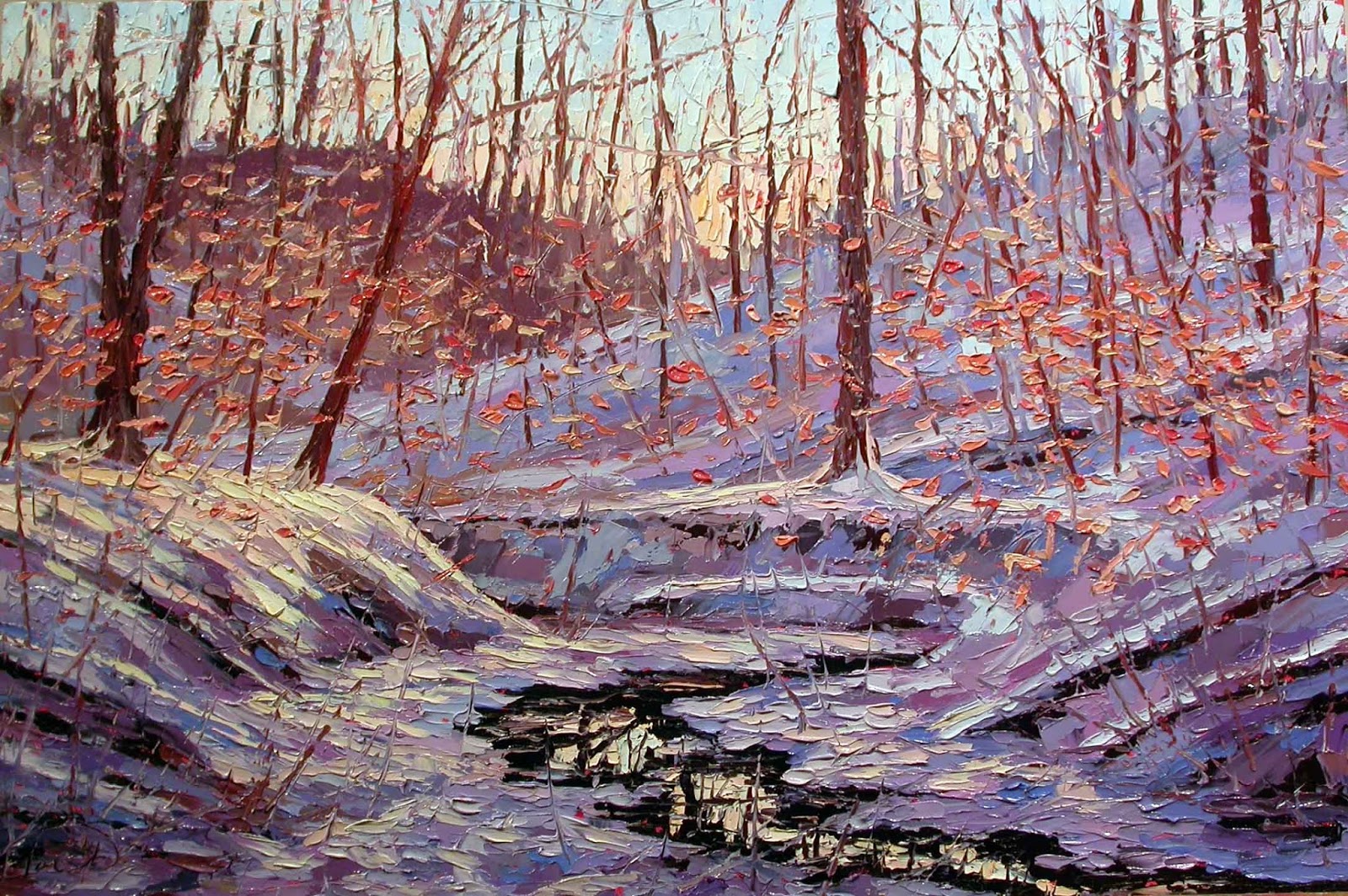
092816 S 30x24 Twilight in the Snowy Forest

I wanted to create a 30" x 24" oil painting inspired by a plein air oil I did on location several years ago.  To be honest, I regret selling this painting. 
"Twilight in the Forest, February 5, 2013", oil on panel, 16"x12", by Charlene Marsh.  SOLD

I set up an "inspiration board" of past plein air snow paintings,in addition to the one above, that I could refer to and pull out the best of the best features. 
I start with an initial sketch using my brush dipped in oil and transparent Primary Red-Magenta.
I mix a black using Ultramarine Blue and Cadmium Red Medium.  I also use Ultra Blue with Primary Red-Magenta and sometimes a touch of Cadmium Yellow.
I have a very simple palette with just six primaries plus white.  I usually mix one or two secondary colors with the primaries and then combine those two secondaries to get a tertiary color.  Or a secondary color with the complementary (opposite on the color wheel) primary color to get a nice range of neutrals from grey to brown.  You can see here where I have mixed an orange(secondary color) using Primary Red Magenta and Cadmium Yellow. I  lightened the primary color, Cerulean Blue with Titanium White.  
Using various combinations of the complementary colors, I could mix a wide range of neutrals to block in the shadows on the snow. 
I continue blocking in the snow, starting with the shadow areas and working to the highlights.
For the sky, I mixed Cerulean Blue with Titanium White and a pale orange color.  The pale orange was blocked in along the horizon line and the blue was painted in higher up on the panel.  I could then gradually combine the two complementaries to get the neutral colors where the two intersect.  Neutrals can be magical!  They add an ethereal glow to the painting.
I pop in some of the sky orange on the creek where the sky is reflected.  I paint in a shale blue for the water mixed from Cerulean Blue, a touch of Cadmium Yellow Light, and a bit of Cadmium Red Medium.  Cadmium Red can be a very strong color so a little goes a long way!

I then work the surface adding the delicate salmon colored ash leaves, branches, trees, weeds, twigs, and more water reflections all weaving across the painting.  I work back and forth between the background and foreground.  Towards the end, I pull out the foreground elements so they sit in front of the background features.  

I was very pleased with the finished painting and the rich tapestry of colors and forms. This painting evokes the same feelings of awe and wonder that the plein air one did, maybe even more so.
"Twilight in the Snowy Forest", Code #092116 30x24, oil on panel, 30" x 24", by Charlene Marsh.

I love to hear your comments and questions!

Thanks and Happy Trails!

Cheers,

Charlene

P.S.  Be sure to sign up for THE ART BRUSH newsletter where you can receive news, tips, special pricing, exhibitions, and more!  As a bonus, when you subscribe, you will immediately receive a FREE one page report on How to Create Health, Wealth, and Harmony Using Fine Art!

Monday, October 26, 2015

20 Practical Tips for Plein Air Painting in Back Country

While I have been painting my entire life, I have been painting "en plein air" since 2000, hiking deep into the forest that surrounds my home and studio.  I tend to go out for the day so these tips are for day trips.  I go out in all four seasons in all kinds of weather.  Brutal heat and snowy cold.  Here are 20 Practical Tips for Plein Air Painting in Back Country I have learned, some the hard way, in no particular order.
  1. Have the proper clothing for the weather.  This can be a matter of life or death and should be considered very seriously, no matter how close to home you may be.  If painting in the snow, wear waterproof snow pants and insulated, knee high, snow boots.  An over coat suited for the temperatures goes without saying.  I remember when I first moved to Brown County and was hiking out in the forest in the deep snow, near dusk, I was so enchanted with the beauty of the fresh, sparkling snow I didn't realize until I was a good mile or two in the woods that I had lost my trail.  Everything looked totally different in the deep snow.  Trees were bent over with the heavy snow and small bushes were buried in it.  My trail was obliterated.  I also realized that my jeans were soaking wet, snow had spilled over the tops of my hiking boots and my feet were wet, I wasn't quite sure where my trail was, and it was starting to get dark.  A wave of panic swept over me.  Thankfully, I was able to drop down off the ridge and down to the creek and follow it back up to my property.  I thought I knew my trail so well, that I had become lackadaisical.  
  2. Dress in layers and wear undergarments that wick away sweat.  Often, hiking out to a painting location, I start sweating and my under shirt can be soaking wet by the time I arrive at my destination even when the temperatures are below freezing.  Wearing clothing that wicks away sweat is important to staying warm and dry especially in cold weather.  You want to wick the moisture away from your body to stay warm.  Several companies make clothing that have no cotton in them with material designed to wick away moisture.  Look for the tag that specifically says the fabric is designed to wick away moisture.  While I love natural fibers, cotton is a material that retains perspiration and won't serve you well in the winter, especially.  Standing for several hours in one spot, I often get chilled especially as the day wanes and the shadows grow long.  In the fall and spring, I will usually have an extra jacket in my back pack to put on as the day cools off.  In the summer, I may tie a light jacket around my waist, just in case I need it.
  3. Carry a compass along with your cell phone.  Practice using it before you need it.  Don't count on GPS.  You may not have a signal in the back country.  And GPS can be flat out wrong.  People have died counting on a GPS.  Don't make that mistake.  I have two GPSs and neither one can find my house. 
  4. Study and carry maps when going into new or unfamiliar territory.  Getting turned around in the forest on the rills and ridge tops and in the valleys can be very disorienting especially if there is a cloud cover and you cannot navigate by the sun or it gets dark.  One time when I first moved out here next to Yellowwood State Forest, I was exploring out in the woods and got turned around and lost my way home.  I ended up climbing up to a ridge top to take a look around and much to my surprise, I could see my barn off in the distance, one ridge over!
  5. Travel light.  Get rid of any gear you don't absolutely need.  One pound here and another there may not seem like much, but it adds up fast.  And if you are like me, a 105 pound weakling, 10-15 pounds is a lot.  Twenty pounds is way too much.  Try carrying around a 15-20 pound bag of cat food for a day. 
  6. Wear a brimmed hat, NOT sunglasses.  A hat with a brim will keep the sun out of your eyes while painting.  A brimmed hat will also keep the rain off your eyeglasses if you wear them.  Sunglasses will distort and darken the colors you see.
  7. Give yourself plenty of time to get back to civilization before it gets dark.  Keep track of how long it took you to get to the painting spot and how long it will take you to get back taking into consideration the terrain.  If you have an uphill climb to get home, leave extra time for that.  Pay attention to the sun.  When the shadows are starting to get long, it is time to pack up.  Since painting the sunset and dusk is one of the most beautiful times to paint and you may want to stay out until the last vestige of sunlight is gone,you should see Point 8.  There have been plenty of times I was packing up and hiking home in the dark.
  8. Carry a flashlight in your pocket if you will be out in the field after dark.  The headlights are great and keep your hands free.  In the winter, I almost always carrying a flashlight and/or headlight because the days are so short and can get dark very quickly.  But, again, don't be lackadaisical no matter what the season.  Once, I got caught out in the woods in the summer in the dark.  The heavy tree cover and lack of any moonlight meant it was pitch black.  I couldn't even see my hand in front of my face.  And I was a good mile back in the woods.  I had to drop down off the trail to the creek bed and follow it along, stumbling, and when I finally got to the point where I had to go up the steep hill with a very narrow path with dropping sides, I called my dog over and hung onto his collar and told him to lead me home.  I guess he was so hungry and ready for dinner, he obliged.
  9. Know your physical limits.  Don't do more than you are physically able to do.  Practice with short expeditions to test your stamina and your gear.  Work up to long treks like you are training for a marathon.
  10. Stay in good shape.  Staying in good shape year round is the best policy.  Easier to stay in shape than try to get back into shape.  Eat good organic, raw, fresh foods and steer clear of food made in a factory.  Eat plants not food made in plants.  Exercise everyday.  
  11. Wear Hunter Orange during the hunting season.  This is required by law during the deer season but I wear it whenever there is anything "in season" just to be safe.  If you aren't sure, wear it.  I have a variety of bright orange long and short sleeve tees, a hoodie, hats, and vests to wear no matter if it is 80 degrees or 10 degrees.  I also make sure any guest has on hunter orange.
  12. Be alert for dangerous animals such as venomous snakes, coyotes, feral dogs, bears, and cougars.  Know the region where you will be hiking and painting.  Learn about potential, dangerous wild animals you may encounter and know how you will respond.  Most wild animals will want to move away from humans but, again, don't be lackadaisical.  I got bit by a copperhead at the edge of my driveway, on Friday the 13th, no less, and I should have been paying better attention.  I had a "Red Flash Warning" (see Tip 16.) but ignored it.  I learned later that copperheads are very aggressive and are one wild animal that does NOT move away nor does it give a warning(like the rattler).  They also have unlimited venom and a spare set of back fangs -- and they know it!  I was laid up for two months with that! 
  13. Poor eyesight can be an asset but keep your glasses safe and near.  I am nearsighted and take off my glasses to paint the landscape.   Everything gets a little fuzzy and the picky details are distilled out of the scene, allowing me to see the major shapes and values and the essence of the landscape.  I carry a glasses case in my backpack to slip them in while painting to keep them safe and handy.
  14. Stay alert.  I tend to go into a deep meditative, trance state when I paint on location.  Nevertheless, one must always remain vigilant on a certain level and always be aware of your surroundings.
  15. Consider self protection.  My dogs go with me and go a long way to filling that "protection" role.  Everything you add to your pockets and pack weigh you down so I like to keep it light.  However, pepper spray and a cell phone are the smart things to do for safety and protection.  
  16. Listen to your intuition.  If you get a bad feeling or what I call a "Red Flash Warning" pay attention and respond appropriately.  Under no circumstance ignore that "feeling".  The neat thing about intuition is that the more you use it, the more it comes to your aid.  
  17. Carry a first aid pack and survival cheat sheet.  So if the worst happens, you are prepared and have a strategy.  Okay, I admit, I don't do this for day trips in familiar areas but that doesn't mean it isn't a good idea.  I have at least studied those survival cheat sheets.
  18. Tell someone where you will be and when you are due back.  Especially if it is an "out of the ordinary" expedition.  I go out every day and pretty much everyone knows it so they should know where to start looking if I turn up missing.
  19. Carry food and water appropriate to the length of the journey.  For day trips, I often eat before I head out and eat when I get back home.  I am usually too busy with hiking and painting to bother eating anyway.  A light snack may suffice.
  20.  Keep your mind on good things. 
    Philippians 4:8  Finally, brethren, whatever things are true, whatever things are honest, whatever things are just, whatever things are pure, whatever things are lovely, whatever things are of good report; if there be any virtue, and if there be any praise, think on these things.

    Happy Trails and safe painting!
    Charlene