Sunday, November 22, 2015

Enchanted Forest Sunset Snow


We had our first snowfall of the season yesterday!  At times, big, fluffy, thick flakes fell covering the ground but it was too warm for the snow to stick too long.  Because it is the firearms deer hunting season, I do not go out to paint in the woods although I still go out for a daily hike.  I keep Kendra on a leash so everyone stays safe, including the deer which she can flush out for the hunters.
To commemorate the first snow of the season, I want to share the creation of this little painting.  I love these sunset scenes in the snowy forest and never tire of painting them.  They are hard and rare to capture on location, "en plein air", so I like to re-capture that energy back in the studio.  The peace and beauty of the forest is unsurpassed at that twilight hour!

As usual, I start by blocking in the darks first.  Then add the snow with the blue sky, turning peach, reflecting off of it.  Then I block in the sky.

At this point, I start to add the trees.  First the major trees then the smaller ones and branches criss-crossing the landscape.  You can see where background elements cross over foreground elements as I work the entire surface.  I add the reflection in the water on the creek.

I make sure to pull out the foreground trees and branches from the background so they sit forward.  Here is the finished painting:
"Sunset in the Snowy Forest", oil on panel, 6" x 8", #111015 s 6x8 no1
Thanks for tuning in!  Happy Trails!

P.S.  Be sure to sign up for my e-newsletter (upper right) to be the first to receive news about paintings in progress, upcoming shows, new, available paintings, painting tips, exclusive specials, and fun insight into the life of an artist!

Warm regards,

Charlene

Sunday, November 15, 2015

Flowers Galore!

This painting is done in the studio.  I started with several sketches to figure out how I wanted to set it up.  Plein air paintings I have done over the years were used for inspiration.  Here's one page from my sketchbook.
I sketched out the painting on the panel with a brush dipped in linseed oil and a magenta cerulean blue mix and started blocking in the colors.
 I start with the darks first and then block in the bright flowers.
  Continuing to lay in the values and colors.
I work over the entire surface of the panel at the same time. 
 I block in the sky last.  Lightening a dark is much easier than trying to make a light value (with white) dark.  In fact, it is impossible!  Now the fun really begins! 
I go back into the painting adding the details of the flowers and leaves and flowing water.  Again, I work over the entire surface at the same time.  Since I work wet into wet, I have to work as fast as possible and stay with it over several days until it is done. 
 Finished painting.  "Flowers Galore", 24" x 36", oil on panel.  #110615 24x36

Thanks for tuning in!  Happy trails!

Sunday, November 8, 2015

Painting a Small Snow Scene

I thought you might enjoy seeing how I create a 6" x 8" painting in the studio.  I use a plein air painting I did on location as reference and inspiration.  The plein air painting was done on a snowy afternoon as dusk set in and turned the sky a peachy rose color.  The color lasts a very short amount of time before the pitch black of night sets in.

I start with a quick sketch on a tinted panel and then block in the darkest darks first.

Gradually  the lighter values are added.  Since this is a snow painting, there are darks and then the snow whites. Not a lot in between.  I work over the entire panel at the same time, going from the background to the foreground and back again.  I block in the scene based on the color and values over the entire surface.
In the end, I pull out any feature that is in the foreground to make sure it pops forward and the background recedes back.  The finished painting:
"Snowy Forest at Dusk", 6" x 8", oil on panel.


Thanks for tuning in.  Please post your comments or questions.  I plan to answer questions in future blogs.  If you are asking it, probably other people are too!  I love hearing from you and appreciate your interest.

Happy trails!

P.S.  Be sure to sign up for my e-newsletter to get updates and new painting demos.

Sunday, November 1, 2015

Plein Air Painting in the Woods, "Waiting For Teddie"

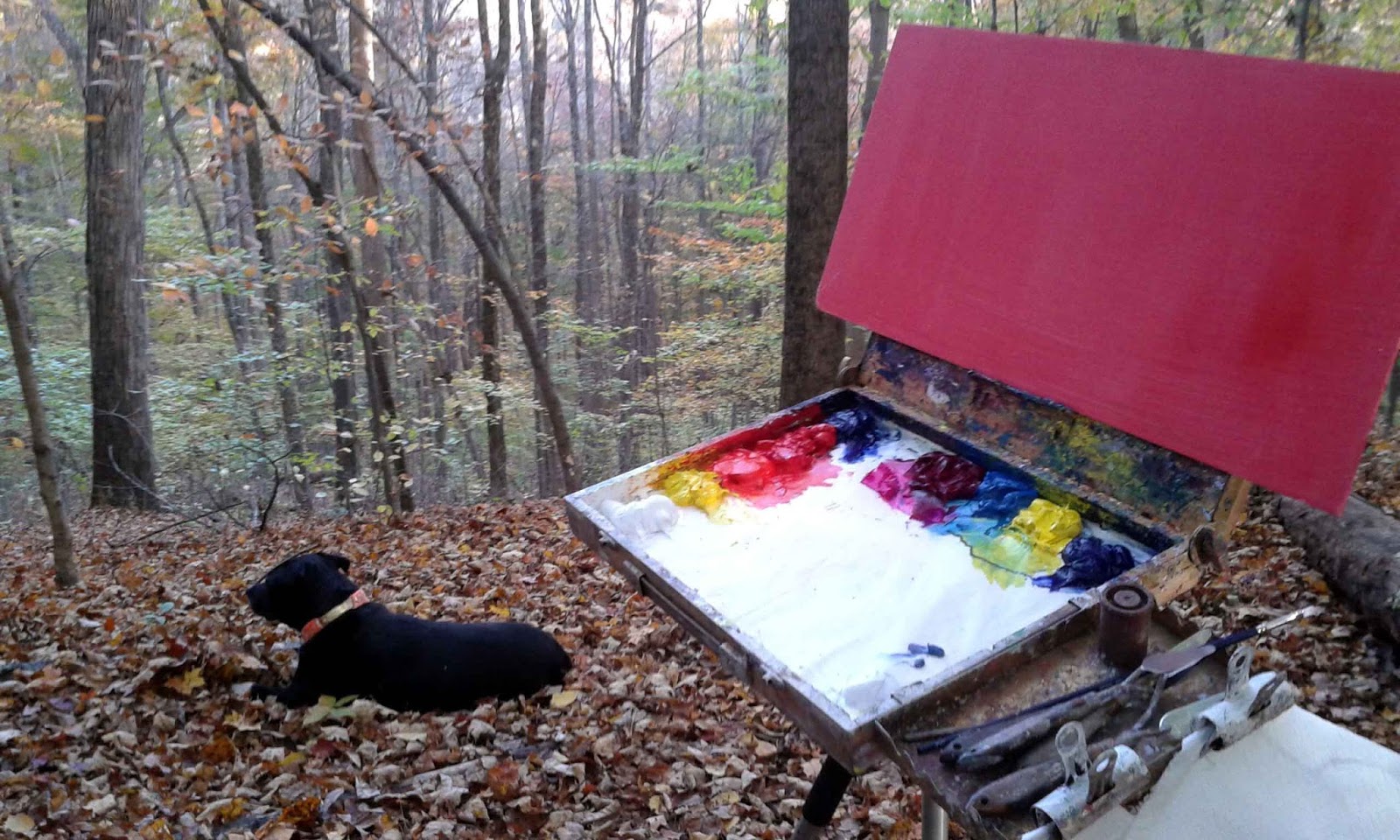
This blog shows how I create a painting "en plein air" out in the forest.  Kendra and I are heading out on the trail to a spot a good mile back on the ridge with a gorgeous view.
The pochade and tripod are set up and ready to go.  I lay out my palette back in the studio before heading out on the trail.  I try to put out as much paint as I think I will need. I start with a panel that has been tinted with a Naphthol Crimson Red.
I lay out the initial sketch using a small brush dipped in Cold Pressed Linseed oil and picking up a mix of transparent magenta and cerulean blue. 
Next, using the palette knives, I lay in blocks of color and values.
The painting progresses. I usually block in the sky near the end of the painting.
I know this photo is hideous and I only include it to show that I was finishing the painting at dusk, as it was getting quite dark.  Before I started packing up, a coyote very nearby started to howl and scream and it was most unnerving!  I was sure glad I had Kendra with me.  She started to bark at the coyote and it must have moved away because I didn't hear it again.  I walked home a mile in the dark using my headlight flashlight to light the trail.
The finished painting is an oil on panel, 12" x 24".  I named it "Waiting for Teddie" because this is a place on the trail we would stop and wait for my old dog, Teddie, during the last two years of his life, to give him a chance to catch up with us before moving on.  He moved slower and slower towards the end of his life but he always wanted to go with us out into the woods.  I still often stop here and sometimes I think I see him in the distance catching up with us on the trail.  


Monday, October 26, 2015

20 Practical Tips for Plein Air Painting in Back Country

While I have been painting my entire life, I have been painting "en plein air" since 2000, hiking deep into the forest that surrounds my home and studio.  I tend to go out for the day so these tips are for day trips.  I go out in all four seasons in all kinds of weather.  Brutal heat and snowy cold.  Here are 20 Practical Tips for Plein Air Painting in Back Country I have learned, some the hard way, in no particular order.
  1. Have the proper clothing for the weather.  This can be a matter of life or death and should be considered very seriously, no matter how close to home you may be.  If painting in the snow, wear waterproof snow pants and insulated, knee high, snow boots.  An over coat suited for the temperatures goes without saying.  I remember when I first moved to Brown County and was hiking out in the forest in the deep snow, near dusk, I was so enchanted with the beauty of the fresh, sparkling snow I didn't realize until I was a good mile or two in the woods that I had lost my trail.  Everything looked totally different in the deep snow.  Trees were bent over with the heavy snow and small bushes were buried in it.  My trail was obliterated.  I also realized that my jeans were soaking wet, snow had spilled over the tops of my hiking boots and my feet were wet, I wasn't quite sure where my trail was, and it was starting to get dark.  A wave of panic swept over me.  Thankfully, I was able to drop down off the ridge and down to the creek and follow it back up to my property.  I thought I knew my trail so well, that I had become lackadaisical.  
  2. Dress in layers and wear undergarments that wick away sweat.  Often, hiking out to a painting location, I start sweating and my under shirt can be soaking wet by the time I arrive at my destination even when the temperatures are below freezing.  Wearing clothing that wicks away sweat is important to staying warm and dry especially in cold weather.  You want to wick the moisture away from your body to stay warm.  Several companies make clothing that have no cotton in them with material designed to wick away moisture.  Look for the tag that specifically says the fabric is designed to wick away moisture.  While I love natural fibers, cotton is a material that retains perspiration and won't serve you well in the winter, especially.  Standing for several hours in one spot, I often get chilled especially as the day wanes and the shadows grow long.  In the fall and spring, I will usually have an extra jacket in my back pack to put on as the day cools off.  In the summer, I may tie a light jacket around my waist, just in case I need it.
  3. Carry a compass along with your cell phone.  Practice using it before you need it.  Don't count on GPS.  You may not have a signal in the back country.  And GPS can be flat out wrong.  People have died counting on a GPS.  Don't make that mistake.  I have two GPSs and neither one can find my house. 
  4. Study and carry maps when going into new or unfamiliar territory.  Getting turned around in the forest on the rills and ridge tops and in the valleys can be very disorienting especially if there is a cloud cover and you cannot navigate by the sun or it gets dark.  One time when I first moved out here next to Yellowwood State Forest, I was exploring out in the woods and got turned around and lost my way home.  I ended up climbing up to a ridge top to take a look around and much to my surprise, I could see my barn off in the distance, one ridge over!
  5. Travel light.  Get rid of any gear you don't absolutely need.  One pound here and another there may not seem like much, but it adds up fast.  And if you are like me, a 105 pound weakling, 10-15 pounds is a lot.  Twenty pounds is way too much.  Try carrying around a 15-20 pound bag of cat food for a day. 
  6. Wear a brimmed hat, NOT sunglasses.  A hat with a brim will keep the sun out of your eyes while painting.  A brimmed hat will also keep the rain off your eyeglasses if you wear them.  Sunglasses will distort and darken the colors you see.
  7. Give yourself plenty of time to get back to civilization before it gets dark.  Keep track of how long it took you to get to the painting spot and how long it will take you to get back taking into consideration the terrain.  If you have an uphill climb to get home, leave extra time for that.  Pay attention to the sun.  When the shadows are starting to get long, it is time to pack up.  Since painting the sunset and dusk is one of the most beautiful times to paint and you may want to stay out until the last vestige of sunlight is gone,you should see Point 8.  There have been plenty of times I was packing up and hiking home in the dark.
  8. Carry a flashlight in your pocket if you will be out in the field after dark.  The headlights are great and keep your hands free.  In the winter, I almost always carrying a flashlight and/or headlight because the days are so short and can get dark very quickly.  But, again, don't be lackadaisical no matter what the season.  Once, I got caught out in the woods in the summer in the dark.  The heavy tree cover and lack of any moonlight meant it was pitch black.  I couldn't even see my hand in front of my face.  And I was a good mile back in the woods.  I had to drop down off the trail to the creek bed and follow it along, stumbling, and when I finally got to the point where I had to go up the steep hill with a very narrow path with dropping sides, I called my dog over and hung onto his collar and told him to lead me home.  I guess he was so hungry and ready for dinner, he obliged.
  9. Know your physical limits.  Don't do more than you are physically able to do.  Practice with short expeditions to test your stamina and your gear.  Work up to long treks like you are training for a marathon.
  10. Stay in good shape.  Staying in good shape year round is the best policy.  Easier to stay in shape than try to get back into shape.  Eat good organic, raw, fresh foods and steer clear of food made in a factory.  Eat plants not food made in plants.  Exercise everyday.  
  11. Wear Hunter Orange during the hunting season.  This is required by law during the deer season but I wear it whenever there is anything "in season" just to be safe.  If you aren't sure, wear it.  I have a variety of bright orange long and short sleeve tees, a hoodie, hats, and vests to wear no matter if it is 80 degrees or 10 degrees.  I also make sure any guest has on hunter orange.
  12. Be alert for dangerous animals such as venomous snakes, coyotes, feral dogs, bears, and cougars.  Know the region where you will be hiking and painting.  Learn about potential, dangerous wild animals you may encounter and know how you will respond.  Most wild animals will want to move away from humans but, again, don't be lackadaisical.  I got bit by a copperhead at the edge of my driveway, on Friday the 13th, no less, and I should have been paying better attention.  I had a "Red Flash Warning" (see Tip 16.) but ignored it.  I learned later that copperheads are very aggressive and are one wild animal that does NOT move away nor does it give a warning(like the rattler).  They also have unlimited venom and a spare set of back fangs -- and they know it!  I was laid up for two months with that! 
  13. Poor eyesight can be an asset but keep your glasses safe and near.  I am nearsighted and take off my glasses to paint the landscape.   Everything gets a little fuzzy and the picky details are distilled out of the scene, allowing me to see the major shapes and values and the essence of the landscape.  I carry a glasses case in my backpack to slip them in while painting to keep them safe and handy.
  14. Stay alert.  I tend to go into a deep meditative, trance state when I paint on location.  Nevertheless, one must always remain vigilant on a certain level and always be aware of your surroundings.
  15. Consider self protection.  My dogs go with me and go a long way to filling that "protection" role.  Everything you add to your pockets and pack weigh you down so I like to keep it light.  However, pepper spray and a cell phone are the smart things to do for safety and protection.  
  16. Listen to your intuition.  If you get a bad feeling or what I call a "Red Flash Warning" pay attention and respond appropriately.  Under no circumstance ignore that "feeling".  The neat thing about intuition is that the more you use it, the more it comes to your aid.  
  17. Carry a first aid pack and survival cheat sheet.  So if the worst happens, you are prepared and have a strategy.  Okay, I admit, I don't do this for day trips in familiar areas but that doesn't mean it isn't a good idea.  I have at least studied those survival cheat sheets.
  18. Tell someone where you will be and when you are due back.  Especially if it is an "out of the ordinary" expedition.  I go out every day and pretty much everyone knows it so they should know where to start looking if I turn up missing.
  19. Carry food and water appropriate to the length of the journey.  For day trips, I often eat before I head out and eat when I get back home.  I am usually too busy with hiking and painting to bother eating anyway.  A light snack may suffice.
  20.  Keep your mind on good things. 
    Philippians 4:8  Finally, brethren, whatever things are true, whatever things are honest, whatever things are just, whatever things are pure, whatever things are lovely, whatever things are of good report; if there be any virtue, and if there be any praise, think on these things.

    Happy Trails and safe painting!
    Charlene

Saturday, October 24, 2015

Best of Show!

I was very honored to receive the Best of Show award in the annual Indiana Plein Air Painters Association(IPAPA) juried member show in August.  The show was held at the Art on the Main Gallery in downtown Elkhart, Indiana.  The award winning painting was selected from 111 plein air entries by 59 artists.  

Ron Monsma, the juror for the show, says the piece demonstrates “a confident handling of thick impasto with great tonality, color, and light. The artist holds the space together while at the same time revealing the abstract nature of her vision.”


"Snow in the Forest, Melting, March 7, 2015", oil on panel, copyright by Charlene Marsh, Inventory Code #030715 16x20

All the best,
Charlene

Wednesday, March 18, 2015

Cougar Sighting

I had the rare and exciting experience of spotting a wild cougar in Yellowwood Forest, Brown County, Indiana yesterday, March 17, St. Patrick's Day, around 7 p.m. in the evening while taking my daily walk in the woods.  I was not too far behind my property, down near the creek, finishing up my two mile circuit, when I spotted a large creature climbing up the hillside maybe 100-200 feet in front of me.  I remembered spotting it as I scanned the hills and then my eyes stopped and came back to it thinking, "What the heck is that?"  I could tell whatever it was, it was large, buff colored, with a round head, round ears, sleek fur, muscular, and with a long, slender, "rope like" tail.  The tail was the dead give away.  No way could it be a coyote.  Eureka!  My God!  It's a cougar!  Also known as a Mountain Lion!  

The Indiana Department of Natural Resources website says that the possibility of spotting one is "almost non-existent" and "remote". Seems the DNR consistently denies any cougars in Indiana despite sightings.  A neighbor about 1/4 mile to the west of my property, spotted one about 15 years ago crossing their back field so the possibility has always been on my radar.  I just never dreamed I would be so lucky as to see one in the wild in my own back woods where I paint and hike daily.

I looked up "cougar" in a book called Animal-Speak by Ted Andrews which talks about the significance of an animal totem or an animal that appears in your life. The Keynote term is "Coming into Your Own Power" with a year round "Cycle of Power".  The deer, being the favorite prey of the cougar, is another animal to study.  The deer is one of my totems so I found that relationship interesting.

Seeing a Mountain Lion in the wild will always stay with me as a very special encounter before he slipped back deeper into the forest and disappeared.  Now when I walk the woods, I scan the steep hills for the chance to spot another one.